

The thermal expansion coefficient is a crucial physical property that describes how a material expands or contracts in response to temperature changes. For PTFE (Polytetrafluoroethylene) bearing strips, understanding this coefficient is essential for applications where temperature variations are common. As a trusted PTFE Bearing Strips supplier, I'll delve into the details of the thermal expansion coefficient of PTFE bearing strips, its implications, and how it relates to our high - quality products.
What is the Thermal Expansion Coefficient?
The thermal expansion coefficient, often denoted as α, is defined as the fractional change in length or volume of a material per degree change in temperature. There are two main types: the linear thermal expansion coefficient (αₗ) which measures the change in length, and the volumetric thermal expansion coefficient (αᵥ). For isotropic materials, αᵥ ≈ 3αₗ.
The thermal expansion coefficient is typically expressed in units of per degree Celsius (°C⁻¹) or per degree Fahrenheit (°F⁻¹). A high thermal expansion coefficient means that the material will expand or contract significantly with a small change in temperature, while a low coefficient indicates more stability under temperature fluctuations.
Thermal Expansion Coefficient of PTFE Bearing Strips
PTFE is known for its excellent chemical resistance, low friction coefficient, and high - temperature stability. However, it also has a relatively high thermal expansion coefficient compared to some other engineering plastics. The linear thermal expansion coefficient of pure PTFE ranges from approximately 100×10⁻⁶ to 200×10⁻⁶ °C⁻¹ in the temperature range of - 20°C to 250°C.
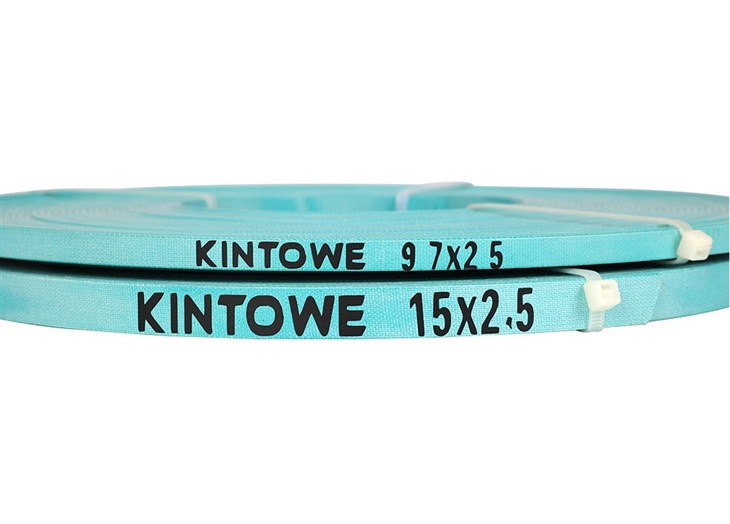

This relatively high value implies that PTFE bearing strips can experience significant dimensional changes when exposed to temperature variations. For example, if a PTFE bearing strip with an initial length of 100 mm and a linear thermal expansion coefficient of 150×10⁻⁶ °C⁻¹ is heated from 20°C to 120°C, the change in length (ΔL) can be calculated using the formula ΔL = αₗ×L₀×ΔT, where L₀ is the initial length and ΔT is the change in temperature.
In this case, ΔT = 120°C - 20°C = 100°C, L₀ = 100 mm, and αₗ = 150×10⁻⁶ °C⁻¹. So, ΔL = 150×10⁻⁶ °C⁻¹×100 mm×100°C = 1.5 mm. This change in length can have a significant impact on the performance of the bearing strip in applications where precise dimensions are required.
Factors Affecting the Thermal Expansion Coefficient of PTFE Bearing Strips
- Filler Materials: Adding fillers to PTFE can modify its thermal expansion coefficient. For instance, Bronze - filled PTFE Guide Bands have a lower thermal expansion coefficient compared to pure PTFE. Bronze fillers act as a constraint to the expansion of the PTFE matrix, reducing the overall dimensional change with temperature.
- Processing Conditions: The way PTFE bearing strips are processed can also influence their thermal expansion behavior. Factors such as the sintering temperature, cooling rate, and compression molding pressure can affect the molecular structure of PTFE, which in turn impacts its thermal expansion properties.
- Temperature Range: The thermal expansion coefficient of PTFE is not constant over all temperature ranges. It may vary depending on the specific temperature interval. At very low temperatures, the molecular motion of PTFE is restricted, and the expansion coefficient may be lower compared to higher temperature ranges.
Implications in Applications
- Mechanical Systems: In mechanical systems where PTFE bearing strips are used, the thermal expansion can affect the fit and clearance between components. If the expansion is not accounted for, it can lead to increased friction, wear, and even mechanical failure. For example, in a high - speed rotating shaft with PTFE bearing strips, excessive expansion due to heat generated during operation can cause binding and overheating.
- Sealing Applications: In sealing applications, the thermal expansion of PTFE bearing strips can impact the sealing performance. A significant change in dimensions can lead to gaps between the sealing surfaces, resulting in leakage. Therefore, proper design and installation techniques are required to accommodate the thermal expansion of PTFE in sealing applications.
Our Solutions as a PTFE Bearing Strips Supplier
As a leading PTFE Bearing Strips supplier, we understand the challenges associated with the thermal expansion of PTFE. We offer a range of solutions to mitigate these issues:
- Custom - formulated PTFE Compounds: We can develop custom - formulated PTFE compounds with specific filler materials to achieve a lower thermal expansion coefficient. For example, our Polyester Resin Guide Strips are designed to provide better dimensional stability under temperature variations.
- Precision Manufacturing: Our advanced manufacturing processes ensure tight dimensional tolerances of PTFE bearing strips. We use state - of - the - art equipment and quality control measures to minimize the impact of thermal expansion on the final product.
- Technical Support: Our team of experts is available to provide technical support and advice on the selection and application of PTFE bearing strips. We can help customers design systems that can accommodate the thermal expansion of PTFE, ensuring optimal performance and reliability.
Other Related PTFE Products
In addition to PTFE bearing strips, we also offer other related products such as PTFE Slideway Soft Belt. These products also have their own thermal expansion characteristics, and we can provide detailed information on their performance under different temperature conditions.
Conclusion
The thermal expansion coefficient of PTFE bearing strips is an important factor that needs to be considered in various applications. While PTFE has a relatively high thermal expansion coefficient, our company, as a professional PTFE Bearing Strips supplier, can offer effective solutions to address this issue. Whether you need custom - formulated compounds, precision - manufactured products, or technical support, we are here to meet your needs.
If you are interested in our PTFE bearing strips or other related products, we invite you to contact us for procurement and further discussion. We are committed to providing high - quality products and excellent service to our customers.
References
- "Engineering Plastics Handbook", McGraw - Hill
- "PTFE: Properties and Applications", Wiley - VCH