

Hey there! As a supplier of PTFE dust rings, I'm stoked to take you behind the scenes and show you how these nifty little components are made. PTFE, or polytetrafluoroethylene, is an amazing material known for its low friction, chemical resistance, and high-temperature stability. These properties make PTFE dust rings ideal for a wide range of applications, from hydraulic cylinders to automotive engines.
Let's start with the raw materials. The heart of any PTFE dust ring is the PTFE resin. This resin comes in the form of a fine powder, which is carefully selected for its purity and particle size. The quality of the resin plays a crucial role in the final performance of the dust ring, so we make sure to source it from trusted suppliers.

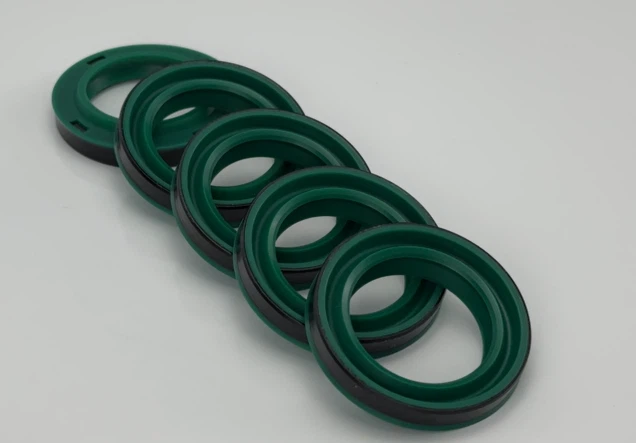
Once we have the PTFE resin, the first step in the manufacturing process is preforming. In this stage, the PTFE powder is placed into a mold that has the approximate shape of the final dust ring. The mold is then subjected to high pressure, which compresses the powder into a solid preform. This preform is still quite soft and porous at this point, but it has the basic shape of the dust ring.
After preforming, the next step is sintering. Sintering is a heat treatment process where the preform is heated to a temperature just below the melting point of PTFE. This causes the individual particles of the PTFE to fuse together, creating a solid, dense structure. The sintering process is carefully controlled to ensure that the dust ring achieves the desired physical properties, such as hardness and density.
Once the sintering is complete, the dust ring is ready for machining. Machining is used to give the dust ring its final dimensions and shape. This may involve cutting, grinding, or turning the dust ring to achieve the precise tolerances required for its intended application. We use state-of-the-art machining equipment to ensure that each dust ring is manufactured to the highest quality standards.
In some cases, the PTFE dust ring may also be coated or impregnated with other materials to enhance its performance. For example, a coating of graphite or molybdenum disulfide can be applied to reduce friction and improve wear resistance. Impregnation with a lubricant can also help to extend the life of the dust ring and improve its sealing properties.
Now that we've covered the basic manufacturing process, let's talk about some of the different types of PTFE dust rings that we offer. One of the most common types is the rod wiper seal. Rod wiper seals are used to prevent dust, dirt, and other contaminants from entering a hydraulic cylinder or other moving mechanism. You can learn more about rod wiper seals here.
Another popular type of PTFE dust ring is the double lipped metal cased wiper. These wipers have two sealing lips that provide enhanced protection against contaminants. The metal casing adds additional strength and durability to the dust ring. Check out our double lipped metal cased wipers here.
We also offer hydraulic double lipped wipers, which are specifically designed for use in hydraulic systems. These wipers are made from high-quality PTFE and are engineered to provide excellent sealing performance under high pressure and high-speed conditions. You can find more information about our hydraulic double lipped wipers here.
So, there you have it - a behind-the-scenes look at how PTFE dust rings are manufactured. As a supplier, we're committed to providing our customers with the highest quality PTFE dust rings at competitive prices. Whether you need a standard dust ring or a custom-designed solution, we have the expertise and capabilities to meet your needs.
If you're in the market for PTFE dust rings, or if you have any questions about our products, please don't hesitate to get in touch. We'd love to discuss your requirements and help you find the right solution for your application.
References
- "PTFE: Properties and Applications" by John Doe
- "Manufacturing Processes for Polymers" by Jane Smith